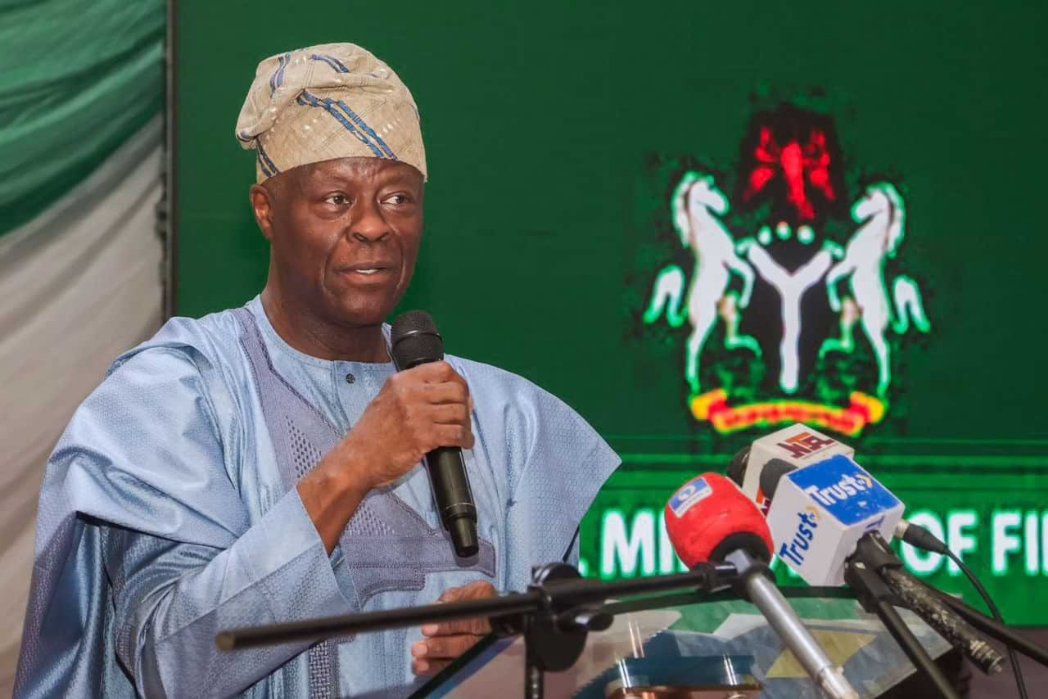
Nigeria’s Minister of Finance and Coordinating Minister of the Economy, Wale Edun, has provided clarification on a recent executive directive requiring certain deductions to be paid directly into the Federation Account, describing it as part of efforts to improve transparency and strengthen domestic revenue mobilisation.
Mr Edun spoke on Friday during a question-and-answer session on the sidelines of the 2026 Technical Group Meeting of the Intergovernmental Group of Twenty-Four (G-24) hosted in Abuja.
He disclosed that a forensic audit of the Nigerian National Petroleum Company is ongoing, as mandated by the Federation Account Allocation Committee (FAAC).
“It is an ongoing forensic audit of NNPC as mandated by FAAC. That is ongoing,” the minister said.
Executive order
Tracing the origin of the directive, Mr Edun said discussions around deductions from the Federation Account had been ongoing and were examined by a subcommittee of the Federal Executive Council (FEC).
The council mandated the committee to review deductions, particularly the cost of collection and the amounts charged for carrying out that function.

“It’s within that context of looking at what should come into the Federation Account and what was going elsewhere that we have now been directed by Mr President… to immediately flow these three elements — management fee, frontier fund, as well as the gas flare penalty — directly to the Federation Account,” he added.
The minister noted that the measure does not prejudice any ongoing legislative process, including discussions relating to the Petroleum Industry Act (PIA), but is intended to improve transparency and accountability in the handling of federation revenues.
An implementation committee, which includes representatives of state governments, has been constituted and is expected to meet next week. Figures relating to the amounts involved will be determined by the committee and made available.
Cost of collection under review
Responding to questions on cost-of-collection charges by revenue-generating agencies, Mr Edun confirmed that the issue had been scrutinised by the FEC subcommittee.
He explained that cost-of-collection deductions are also taken from the Federation Account and are therefore subject to review.
Under existing financial regulations and the Fiscal Responsibility Act, revenue-generating agencies are limited in what they can retain, with surplus required to be remitted to government. The government is also examining the overall quantum being spent to ensure it aligns with statutory provisions.
Domestic resource mobilisation
Mr Edun linked the reforms to broader economic conditions, including elevated global interest rates and limited access to affordable financing for developing countries.
“At a time when financial markets are particularly unfriendly to developing countries, we have to look at the alternative, and the alternative is our own funds, our own resources,” he noted.
He distinguished between self-liquidating project finance, such as toll roads that repay investors over time and borrowing that constrains spending on health, education and infrastructure.Strengthening domestic savings and improving revenue efficiency are critical to reducing pressure from debt servicing.
He also highlighted recent monetary and exchange rate reforms, stating that improved incentives for saving in naira and increased investor confidence are supporting capital market development.
Digital revenue reforms
The minister said digitisation of revenue collection is central to improving transparency.
He noted that the Federal Executive Council has directed that government revenues should no longer be collected in cash, with a deadline set for implementation.
Revenue-earning agencies are being placed on a unified technical platform to enable real-time monitoring of payments and outstanding obligations.
“Once you digitise, you automate, immediately it becomes an issue that is off the table,” he said.
Investor concerns and tax engagement
Addressing concerns about capital gains tax and private equity flows, Mr Edun said the government remains open to dialogue. He acknowledged that sudden capital exits could negatively affect markets and said the Tax Implementation Committee would engage stakeholders.
READ ALSO: NNPC’s CEO visits Dangote Refinery, seeks to forge strategic alliance
“We like patient capital,” he said, adding that Nigeria seeks long-term investments that create jobs and support economic growth.
On social protection, Mr Edun said the direct benefit transfer programme launched by the administration aims to reach 15 million households.
He said 9.1 million households have benefited at least once, with about one million additional beneficiaries set to receive payments soon.
The programme relies on biometric identification through the National Identity Number (NIN), alongside bank accounts or mobile wallets, to enhance transparency and verification.
The remarks come amid broader fiscal and financial sector discussions.
The 2026 Technical Group Meeting of the Intergovernmental Group of Twenty-Four (G-24), hosted by Nigeria in Abuja, focused on mobilising finance for sustainable, inclusive and job-rich economic transformation amid rising debt pressures and tightening fiscal space across developing economies.
Mr Edun highlighted that the ongoing measures are aimed at strengthening transparency, expanding fiscal space and improving the management of public resources.