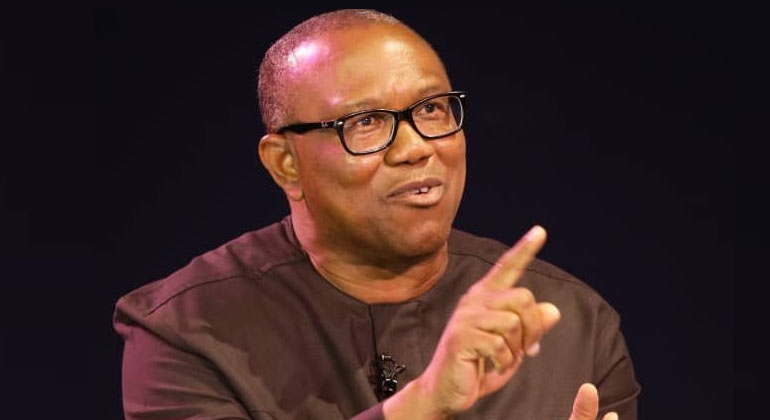
Former presidential candidate Peter Obi has criticised plans to power the Aso Rock Presidential Villa with solar energy, warning that the move suggests neglect of Nigeria’s national electricity grid.
The remarks were contained in a statement released on his X account in reaction to reports that the Presidential Villa may disconnect from the national grid to rely fully on solar power.
The criticism comes amid persistent power supply challenges nationwide and renewed debate over government’s commitment to fixing the electricity system.
What Obi said
In the statement, Obi recalled a campaign promise attributed to President Bola Ahmed Tinubu, who pledged that Nigerians should not re-elect him if he failed to provide steady electricity within four years.
Obi argued that the national grid has continued to perform poorly for more than two years into the administration.
- “Those were the powerful words then that inspired hope among Nigerians who longed for light in their homes, stability for their businesses, and growth for their nation. Yet, while Nigerians are still grappling with that unfulfilled, categorical electoral promise – and without clear communication on the obstacles,” he stated
- According to him, the decision to disconnect the seat of power from the national grid raises concerns about the government’s commitment to improving the electricity supply nationwide.
- “It is a gross neglect and deeply worrisome when the seat of power abandons the national grid. One would expect government institutions to lead efforts to strengthen and expand the grid so that other establishments, and ultimately, citizens can benefit,” he said.
Backstory
Reports about plans to transition the Presidential Villa to solar energy gained attention following provisions in the 2025 budget allocating about N10 billion for solar power infrastructure, alongside further allocations in the 2026 budget for upgrades and maintenance.
The development comes more than two years into the current administration, during which Nigeria has continued to face grid instability, frequent system collapses and limited generation capacity.
Electricity supply remains a major constraint for households and businesses, many of which rely on costly diesel and petrol generators to supplement unreliable grid power.
More details
Obi said that while renewable energy adoption is commendable and necessary for the future, the development reflects a deeper governance concern.
- He argued that leadership should not isolate itself from the daily struggles faced by citizens, noting that Nigerians continue to deal with unreliable power supply and security challenges.
- “You cannot tell the people to fast while feasting yourself, securing yourself while Nigerians remain unsecured,” he stated.
- The former Anambra State governor said Nigerians may not expect complete fulfilment of campaign promises but expect visible effort, measurable improvements and clear explanations when gaps exist.
- He emphasised that leadership must prioritise public welfare and ensure that policies reflect compassion and commitment to the governed rather than detach from it.
What you should know
Nigeria’s power sector has faced repeated instability in recent years, with multiple grid collapses highlighting the fragility of the national electricity system. In 2024 alone, the grid collapsed nine times, making it one of the most unstable years for power supply.
- As of early 2026, the grid has already experienced at least one nationwide collapse, with outages frequently attributed to gas supply shortages, transmission bottlenecks, and technical faults.
- Data from the Nigerian Electricity Regulatory Commission (NERC) January 2026 factsheet shows that grid-connected power plants consistently operate below installed capacity, reflecting persistent availability challenges across the generation segment.
- According to the report, Nigeria’s total installed generation capacity stood at 13,625 megawatts, but only an average of 4,901 megawatts was available for dispatch during the month, representing a Plant Availability Factor (PAF) of 36%.
- The Average Load Factor (ALF) was recorded at 90%, indicating that about 4,421 megawatts per hour of available power was dispatched and consumed. This points to strong demand and limited reserve margins within the system, leaving the grid vulnerable to further failures.