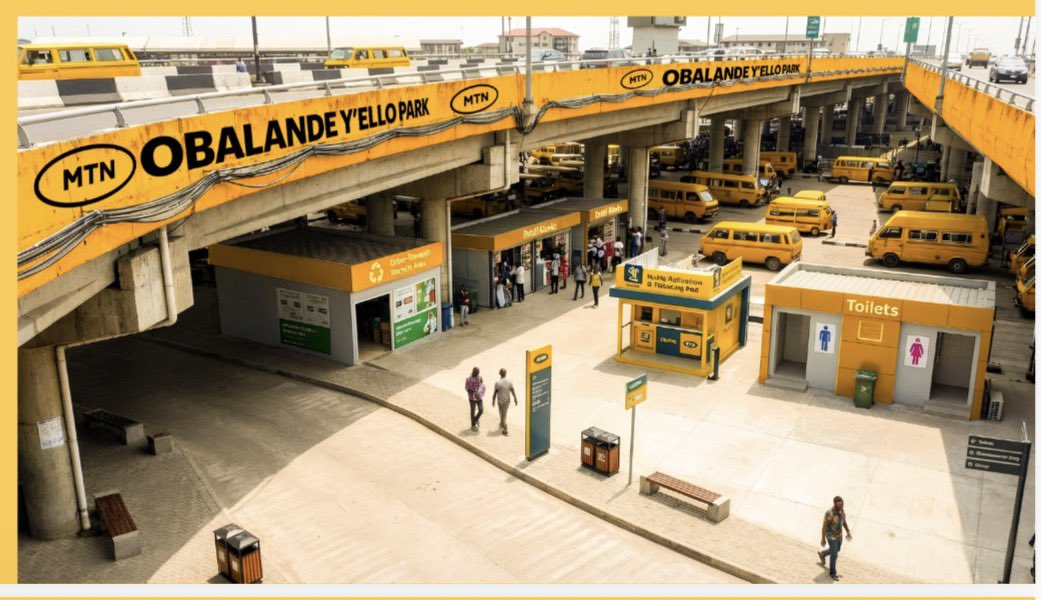
The Lagos State Government has announced plans to collaborate with MTN Nigeria to redevelop and transform the Obalende under-bridge into a modern transport hub to be known as Y’ELLO Bus Park.
This was disclosed by the Commissioner for the Environment and Water Resources, Tokunbo Wahab, in a statement shared via his X page.
According to the Commissioner, the redevelopment is aimed at converting what he described as a previously degraded and notorious space into a functional, secure, and community-focused facility.
What he said
Announcing the project, Wahab said the new Y’ELLO Bus Park will feature an organised and regulated transport terminal, a recycling drop-off station, a road camp for Lagos Waste Management Authority (LAWMA) sweepers and security agencies, over 60 public toilet fixtures, kiosks, and other essential amenities for commuters and residents.
“This redevelopment will convert what was once a notorious and degraded space into a functional, secure, and community-centred facility,” he stated.
He added that the design of the bus park prioritises safety, health, and aesthetics, with solar-powered lighting to improve night-time visibility, reduce blind spots, and enhance the effectiveness of CCTV systems in curbing criminal activities within the Obalende axis.
According to Wahab, a biodigester system is also being introduced to sustainably manage wastewater generated within the park, while a dedicated recycling station will discourage illegal waste disposal in the area.
More details
The Commissioner noted that the project aligns with the state’s climate responsibility goals, with the installation of solar panels to support long-term energy efficiency and reduce carbon emissions.
He also disclosed that tree planting is planned as part of the redevelopment to improve air quality and enhance the overall visual appeal of the environment.
“This project reflects our resolve to reclaim public spaces, make them functional, sustainable, and safe, and ensure they serve the needs of Lagosians in a modern, responsible way,” Wahab said.
Backstory
The Obalende under‑bridge area has long been a hub for open defecation, indiscriminate waste disposal, and poor sanitation, with illegal occupants and street urchins causing concern among residents and officials.
- Authorities have repeatedly evicted illegal parks, garages, traders, and structures at Obalende, dismantling shanties and clearing commercial vehicles and traders who had converted the under‑bridge area into informal motor parks, a role that contributed to traffic chaos and encroachment on public space.
- Recently, enforcement agencies took action against criminal elements and hoodlums operating around Obalende and nearby bus terminals, arresting more than 20 suspects linked to attacks on commuters and residents.
Why this matters
The redevelopment forms part of Lagos State’s broader efforts to regenerate public infrastructure, improve urban mobility, and enhance environmental sustainability.
The planned, organised and regulated bus park would reduce disorder around informal loading points, improve traffic flow and security, and make public transportation safer and more predictable for commuters linking parts of Lagos Island to the mainland and other key areas of the state.
What you should know
Lagos State has a history of working with private partners to deliver infrastructure.
One of the public-private partnerships in the state is the International Finance Corporation (IFC) partnership with the State Government to support the development of two bus corridors in Abule Egba-Command and Ile Iwe-Ile Epo, to improve public transit access and reduce commute times for more than 150,000 daily passengers.
- At the national level, the Federal Executive Council (FEC) recently approved three major PPP projects that are expected to attract more than N6.43 trillion (about $4.29 billion) in private capital into the Nigerian economy. These projects include deep seaports in Bakassi and Ondo, as well as the Katsina-Ala Hydropower Plant, all fully financed by private investors under PPP arrangements.
- In 2025, the Federal Government, through the Infrastructure Concession Regulatory Commission (ICRC), disclosed that more than $500 million was attracted into the Nigerian economy through Public-Private Partnership (PPP) projects within one year.
Public-private partnerships enable governments to deliver large infrastructure and public service projects more effectively.