Energy experts have called for deeper collaboration between government institutions and private sector players to upgrade national grid systems and accelerate regional power integration across West Africa.
The panellists spoke at a session in the West Africa Energy Cooperation Summit on Wednesday in Accra, Ghana, where top officials outlined strategies to increase investment, improve transmission stability, and build a unified electricity market for the subregion.


The summit convened energy regulators, government ministers, utility operators, investors, and innovators from across the world, all sharing a common objective to chart a more resilient, reliable, and sustainable energy future for West Africa.
The summit opened on Tuesday with discussions centred on financing and de-risking clean energy projects, advancing regional power trade and transmission infrastructure, and accelerating private sector participation in off-grid and distributed energy markets.
On Wednesday, experts examined existing market challenges, identified areas of opportunity, and highlighted the critical role private capital should play in building a modern transmission backbone for the region.
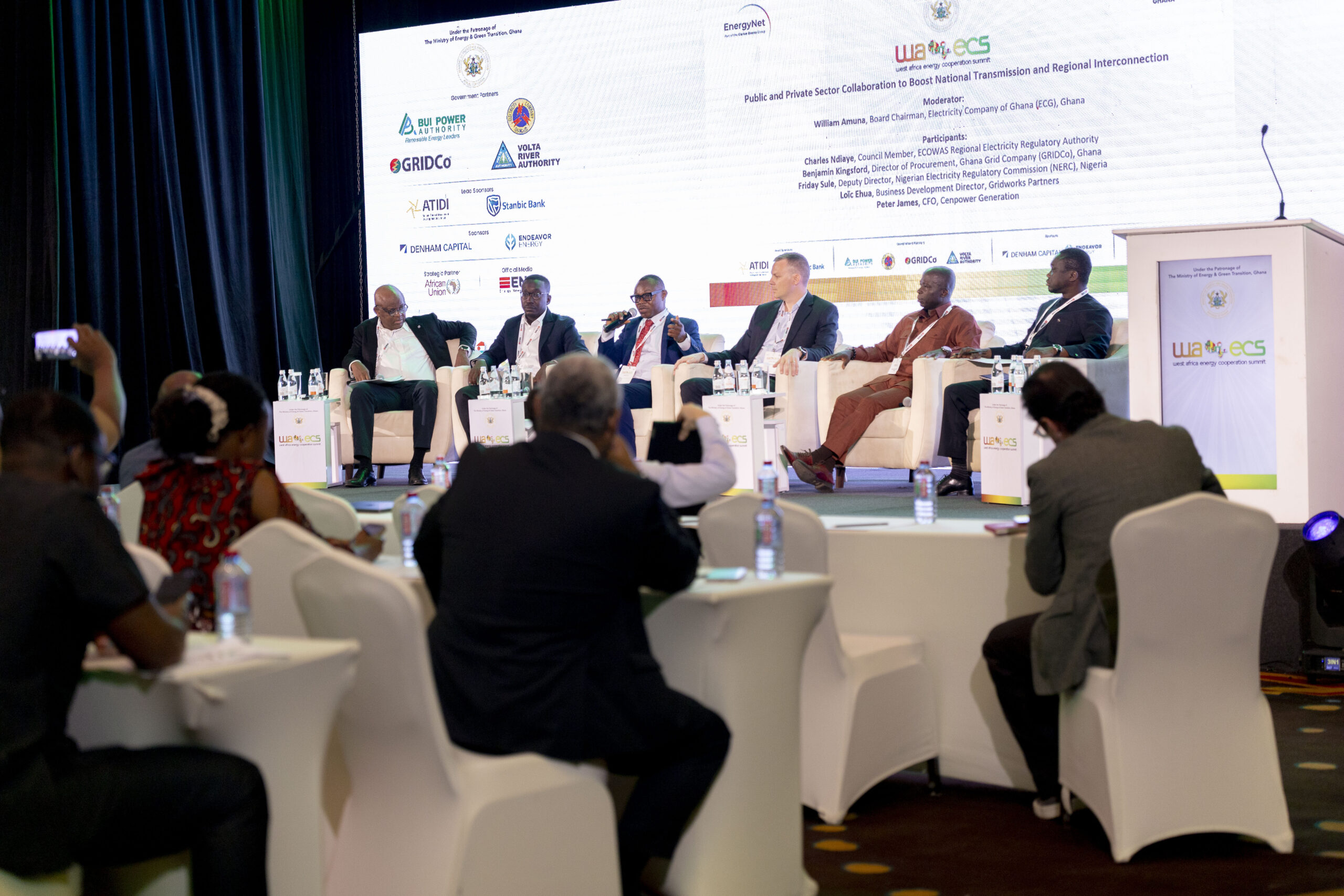
A panel session on “Public, Private Sector Collaboration to Boost National Transmission and Regional Interconnection in West Africa” was moderated by Board Chairman, Electricity Company of Ghana, William Amuna.


The speakers included the Business Development Director, Gridworks Partners, Loïc Ehua; Director of Procurement, Ghana Grid Company (GRIDCo), Benjamin Kingsford; Council Member, ECOWAS Regional Electricity Regulatory Authority, Charles Ndiaye; Deputy Director, Nigerian Electricity Regulatory Commission (NERC), Friday Sule; and the Chief Financial Officer of Cenpower, Peter James.
The key point of discussion was the transition from traditional bilateral power trade agreements to a more structured regional electricity market.
The speakers discussed major interconnection projects such as the CLSG 225-kilovolt transmission line linking Côte d’Ivoire, Guinea, Liberia, and Sierra Leone, and the OMVG interconnector connecting Gambia, Guinea, Guinea-Bissau, and Senegal.
The panellists reaffirmed that public financing alone cannot deliver the scale of infrastructure West Africa requires.
Mr Ehua, the business development director at Gridworks Partners, noted that while investors remain interested in the West African market, strong political commitment is the foundation for success.
“We need governments to show willingness and put structures in place to respond to the urgency of investment,” he said, urging regional governments to remove bureaucratic bottlenecks and reduce policy uncertainty.
The Director of Procurement, Ghana Grid Company (GRIDCo), Benjamin Kingsford, explained that Ghana is open to new partnership models that allow private financing while retaining public ownership of critical grid infrastructure.
“We want GRIDCo to remain the owner, but private investors can support key elements,” he said, noting a shift towards more flexible investment frameworks.
In his submission, Council Member, ECOWAS Regional Electricity Regulatory Authority, Charles Ndiaye, recalled that electricity has historically been viewed as a sovereign asset in Africa, limiting private participation.
That model, he noted, is changing rapidly. “Public funds should go to hospitals, schools and roads. Electricity is purely business,” he stated, calling on countries to prioritise regulatory openness and risk-sharing mechanisms.
From Nigeria, Deputy Director, Nigerian Electricity Regulatory Commission (NERC), Friday Sule, emphasised the importance of harmonised reforms across the region.
“All hands must be on deck,” he said, arguing that alignment in law, policy, and tariff structure will boost investor confidence and speed up integration.
Representing private interests, Chief Financial Officer, Cenpower, Peter James, stressed that investors place a high value on stable regulatory systems and security.
He pointed out that capital will flow more readily when markets demonstrate predictable pricing, efficient governance, and transparent risk management.
Technology also featured prominently in the discussions.
READ ALSO: West Africa Energy Summit opens in Ghana
Messrs Kingsford and Sule highlighted artificial intelligence (AI) as a tool for improving grid efficiency, real-time monitoring, and market settlement accuracy.
Mr Ehua added that data-driven planning and automation could transform West Africa’s energy ecosystem if governments embrace innovation at scale.
A consensus emerged that public-private partnerships remain central to the region’s energy future.
Speakers acknowledged persistent challenges but expressed optimism about the progress underway.
“Countries are taking the right steps,” Mr James said, noting growing momentum around power sector reform.
On his part, NERC’s Mr Sule reinforced that political leadership will ultimately determine the success of regional integration, while Mr Ehua maintained that energy remains a highly bankable sector for long-term investment.
In his final intervention, Mr Ndiaye concluded with a decisive appeal: “We must take risks. If the state controls the market fully, investors will stay back. To move forward, we must build together.”
He stressed that a blend of public planning and private investment is essential to accelerate grid development.