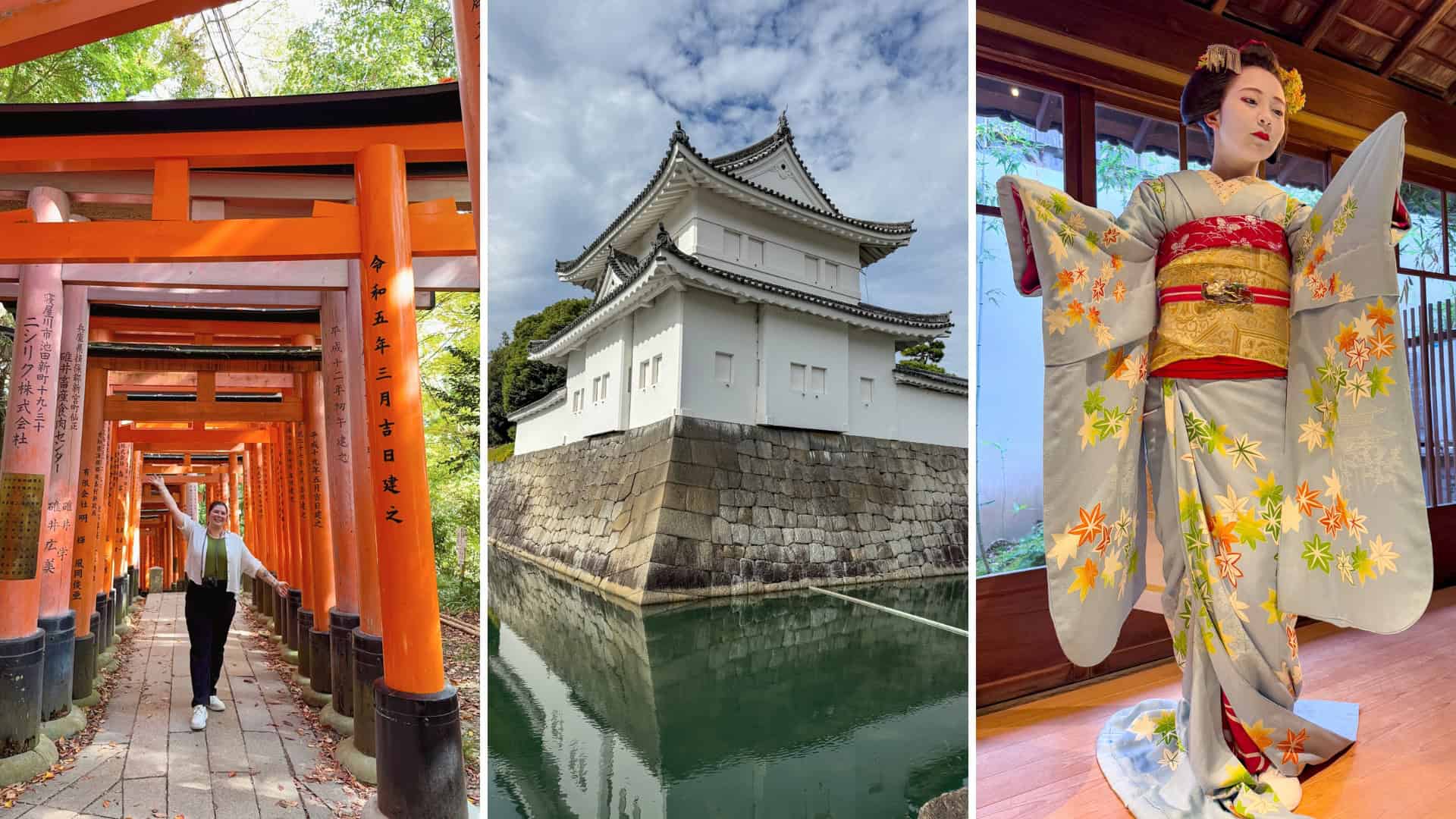
When it comes to planning a trip to Japan, chances are visiting Kyoto is going to be high up on your must-do list — as it should be! Kyoto is a fascinating city, with tons of history, great food, and a completely different vibe than Tokyo. While Tokyo is all skyscrapers and frenetic energy, Kyoto is more relaxed and filled with temples and tea houses.
I personally preferred Kyoto to Tokyo (like, by a lot!), but I learned several things from my own trip that I wish I’d known in advance.
For example, Kyoto is quite a spread-out city, and it’s not as easy to get around here as it is in Tokyo (Kyoto relies less on the metro and more on buses, bikes, and taxis). Kyoto also has a handful of extremely popular tourist attractions that get VERY busy and crowded at certain times of day. So you really need to do some planning in advance in order to truly enjoy a visit to Kyoto.

Other than plotting out my Kyoto itinerary in advance to mix in both the major tourist sites and some less-popular spots, I also made sure to book some unique tours in Kyoto that helped me delve a bit deeper into the history and culture of the city. This was 100% the way to go!
How I find the best tours
I almost always book guided tours when I travel; I LOVE learning new things, and a good walking tour or food tour or day trip with a local guide really can transform a destination for me.
I often get questions from readers asking how I find some of the tours and experiences that I end up writing about. And the answer is simple: tons of research! I do lots of reading and research before a trip; I read travel blogs, watch videos, “explore” certain areas on Google Maps, and scour tour websites.
One of the resources I use more often than you’d think is Viator, which is basically an online marketplace for tours of all types. I use Viator like a planning tool; I search by destination and by tour type (i.e. walking tours, food tours, day trips, etc.), comparing all the different options. I make note of the tours with the most reviews and the highest scores, and I often find fascinating activities that I definitely would not have stumbled across otherwise.

I did the same thing before going to Kyoto, finding such unique tours on Viator that I actually re-planned my entire 4-day itinerary so I could do things like meet a geisha, walk across a nightingale floor, cook my own ramen, and more!
Read on to learn about all the unique tours I took in Kyoto.
Note: This post is brought to you as part of a paid partnership with Viator, but I booked all these tours using my own money while in Kyoto! As always, my opinions are based on my own personal experiences.
My favorite tours in Kyoto
In Kyoto, you absolutely can book an “everything in a day” tour to simply tick off all the main sights if that’s all you want to do. Or you can do what I did and book some very specific tours that focus on one site or subject in more detail.
Here were my favorite Kyoto tours I took:
1. Nijō Castle tour

Surprisingly (to this history nerd, at least), Nijō Castle isn’t generally one of the overcrowded sites in Kyoto. Which is crazy to me since it’s part of a UNESCO World Heritage Site recognizing the “Historic Monuments of Ancient Kyoto” and is absolutely fascinating.
Nijō Castle dates back to the early 1600s, when it was built by Tokugawa Ieyasu, the founder of the Tokugawa shogunate. Japan was an Imperial empire in those days, with the emperor as the head of the country. But the shogun (the head of Japan’s military and its samurai class) actually held all the political power.
The emperor and shogun did not live in the same city; the emperor lived in Kyoto, while Tokugawa Ieyasu and his shogun descendants ruled from Tokyo (Edo). But the shogun still needed a castle in Kyoto for when he came to town to meet with the emperor — which is where Nijō Castle comes in.

I booked this 90-minute guided tour to learn all about it. Sure, I could have visited on my own, but having a guide to explain the delicate relationship between emperor and shogun and to point out specific details inside the palace was so much better than just reading a couple info plaques.
The tour met up near the castle and included a walk through the castle grounds and gardens, plus guided entry into Ninomaru Palace. (Nijō Castle actually has two separate palaces inside, Ninomaru Palace and Honmaru Palace; Ninomaru is the larger of the two, and does not require a timed entry ticket.)

My favorite part of the palace was its uguisubari or “nightingale floors.” These floors make a distinct chirping sound when you walk on them — like the sound of birdsong. Legend has it that the shogun had these special floors installed to make it harder for ninja assassins to sneak up on him. And, as someone who was at one point obsessed with the Tales of the Otori books (in which a boy with magical abilities learns how to walk silently across nightingale floors in order to kill a warlord), I was geeking out over walking across real ones.
I did this tour on my first day in Kyoto, which was a great intro to the imperial history of the city.
>> Book the tour I took: Nijo Castle World Heritage Guided Tour with Admission
2. Gion geisha walking tour

Kyoto is known for its geisha culture, which dates back to the 1700s and grew to a height in the 1920s when there were more than 80,000 geishas throughout Japan. Kyoto is home to five separate hanamachi, or geisha districts where geishas (or geikos, as they are known in Kyoto) and apprentice maikos live and work.
Gion is Kyoto’s most well-known geisha district (it’s actually home to two distinct geisha districts), and it can get very crowded during the day. Which is why I specifically booked a guided walking tour here at night. Parts of Gion can still be busy in the evenings, but it’s much easier to find quiet streets after dark.
This is the geisha-focused walking tour I booked, which met up near Pontocho Alley (another geisha district) and then strolled through the streets of Gion. We walked along the Shirakawa Canal, crossed Tatsumi Bridge, and ended at Yasaka Shrine, which is open 24 hours.


Along the way, our guide shared the history of geishas in Japan and in Kyoto specifically. We learned about how the art began, how it evolved, and how modernization has changed things. (At one point, Kyoto was home to thousands of working geikos and apprentice maikos; today, there are an estimated 250 total in the city.)
We learned the difference between maiko and geiko (the white-painted faces and elaborate kimonos and hair-dos actually belong to the apprentice maikos, did you know?), learned a bit about the process of becoming a maiko/geiko, and learned how to identify an okiya house where maikos live while they are training.

Nighttime is generally the best time to potentially spot a maiko or geiko out on the streets going to/from entertaining at an ochaya, or tea house, though we did not see any while we were out. It was still such an interesting tour, though, and I learned so much!
Note: If you do happen to see a geiko or maiko when you’re out and about in Gion or any other geisha district in Kyoto, you are not really supposed to photograph/film them or bother them in any way. It’s become a big problem in Kyoto, to the point where they have actually banned photography altogether on certain streets. But if you want photos of a maiko or geiko, keep reading!
The tour I did ended at Yasaka Shrine, and then I walked on my own over to Yasaka Pagoda (Hōkan-ji Temple) to see it lit up after dark (it’s a much quieter time to visit than during the day!). If you want to see Yasaka Pagoda as part of a tour, this Gion walking tour includes it.

>> Book the tour I took: Kyoto Gion Geisha District Walking Tour – The Stories of Geisha
3. One-hour geisha show
If you want to know what my very favorite tour I took in Kyoto was, it’s this one!
You *may* get lucky enough to spot a maiko or geiko “in the wild” in any of the geisha districts in Kyoto. But as I mentioned above, you’re discouraged from bothering them on the street or even snapping photos in most cases. If you want to feel less like a paparazzi, the good news is that there are several tours you can book to learn more about these interesting women in a way that’s more educational, consensual, and culturally rich.


I booked this “1 Hour Geisha Show” on a whim in Kyoto; I didn’t even know this was something tourists could do, as I always assumed geisha and maiko only performed for important guests in exclusive teahouses. But, as it turns out, there are many of them who are happy to share their talents and stories with tourists, too!
The tour I booked has a few different versions all run by the same company, but I specifically opted for the “1 Hour Show in Tea House” tour (once you choose your date and number of guests on Viator, you can see the different tour options). In this version of the tour, you’ll go to a tea house on Kamishichiken Street, which is the oldest hanamachi (geiko district) in Kyoto.
We met with a maiko named Fumiyui (these tours usually say “geisha,” but it’s more likely you’ll meet a maiko — which is actually good, as they are the ones with the more elaborate kimonos and hair decorations) and the woman who runs the okiya. We learned about both maiko and geiko and their different attire and lifestyles, and then Fumiyui performed two beautiful dances for us.


After the dancing, we had a Q&A session with Fumiyui (with our tour guide translating), where we got to ask her everything from why she decided to become a maiko to her skincare routine under her white face makeup. She was so sweet and quite open with us.
Then we got to learn a common tea house game and play it with Fumiyui.

Lastly, we left the tea house and walked with Fumiyui over to the Kitano Tenmangu Shrine, where we talked a bit about Shintoism and took some last photos of and with our new maiko friend. This was such a beautiful experience, and I’ll never forget it!
(Also, Kitano Tenmangu Shrine is stunning, and I’m so glad I got to see it while in Kyoto.)


You can also book this same tour in a Gion theater, but I really loved getting to visit a tea house and going over to the shrine with Fumiyui afterwards. The version of the tour I did is not offered every day and is more expensive, but it seemed much more intimate and unique!
If this tour is booked up, some other options you can try include:
>> Book the tour I took: 1 Hour Geisha Show in Kyoto
4. Ramen cooking class

Japan is known worldwide for its food; most notably its sushi and its noodles. But, since I don’t love sushi (shhh, I’m sorry, it’s a texture thing), it was all about the various noodle dishes for me — I couldn’t get enough noodles!
And so while there are undoubtedly classes in Kyoto where you can make your own sushi, if I was going to take a food-related tour or cooking class, I wanted it to revolve around noodles. Luckily for me, there’s an excellent spot in Kyoto called the Ramen Factory that offers cooking classes!
I booked this ramen cooking class through Viator (it was one of the tours I stumbled upon while browsing through all the Kyoto tours that I wasn’t even looking for!), and while it’s a pricey bowl of ramen in the end, the whole experience was so much fun.
This class is appropriate for everyone, from people who aren’t very good cooks (hi, it’s me) to families — there were even a couple kids in my class! The classes are in English, too, in case you’re worried about that.

We created a customized bowl of ramen from start to finish, right down to making our own noodles from scratch. We also got to blend our broths and add whatever toppings we wanted. I booked my tour in the late afternoon so my bowl of ramen was finished right around dinner time.
>> Book the tour I took: Ramen Cooking Class at Ramen Factory in Kyoto
5. Fushimi Inari guided hike*
I have to add a caveat here because I did not do this exact tour, but I kind of DIY’d a version of it, and definitely think it’s the best way to experience the Fushimi Inari shrine if you have the time.

Fushimi Inari is one of the most famous spots in Kyoto, with its paved paths passing beneath thousands of those famous vermillion torii gates. And while you’ve definitely seen photos of people posing beneath those red-orange gates, what you might not know is that the gates extend up an entire mountain — and there are multiple ways to reach the top.
The part of Fushimi Inari that most people see is towards the bottom of the shrine. Near the main shrine entrance, it’s usually a sea of people unless you visit quite early in the morning or later in the evening. Want to go between like 9 a.m. and 4 p.m.? Then you’re going to be sharing the experience with a few thousand strangers at least.


I had read about several alternate paths up the mountain, though, and set out on my own to find one. I had a couple false starts (I’ll have to write about my version of this hike some other time), but eventually found one of the paths. I did have to go with the flow of the horde for a short time, but then peeled off the main trail and climbed Mt Inari using back paths that went through quiet bamboo groves and past moss-covered forest shrines.
I used this “back way” to climb to the top of Mt Inari, and then walked back down through all the torii gates. For me, this was perfect; the hike up was incredibly peaceful (and the top of Mt Inari was honestly pretty quiet, too!), and then I was on the downhill as I passed everyone else climbing up.


The hike took me several hours (granted, I did get lost twice and stopped A LOT to take photos), but it was a half-day well spent as far as I was concerned. After the fact, though, I discovered this “hidden hiking tour” of Fushimi Inari on Viator and was really sad I hadn’t found it before my trip!
This guided hiking tour skips the Fushimi Inari entrance altogether, opting instead to meet in a small neighborhood and hike a different “back way” up the mountain. You’ll walk through a natural bamboo forest, visit hidden shrines, and learn as much as you want about Fushimi Inari, religion, nature, and everything else along the way.

While my hike was mostly on paved trails and up concrete steps (quite a lot of steps), this “hidden” hiking tour takes you up the mountain mostly on dirt paths that you might not be able to follow/find without a guide. You’ll end up on the top of the mountain and then have a chance to get your torii gate photos before heading back down and ending at the main entrance to the shrine.
If you want to hike Fushimi Inari but don’t want to figure out the trails on your own (because they admittedly can be confusing!), then I think a hiking tour like this would be great. Just note that it takes at least 3 hours, and it is a proper hike — so good shoes and a decent level of fitness are highly recommended!

>> Book this tour: Fushimi Inari Hidden Hiking Tour
Other great Kyoto tours
All those tours plus the other sightseeing I did easily filled my 3.5 days in Kyoto. But, if I’d had more time (honestly I wish I would have had at least 5 days!), these are some other Kyoto tours I bookmarked but just couldn’t squeeze in:
- Nishiki Market food tour – I did my own “progressive dinner” at Nishiki Market one evening, getting things from as many food stalls as possible. And it was great! But food tours are always my favorite kind of tours, so I wish I would have had time to take this Nishiki Market brunch tour. I’m sure I would have had even better food and learned more with a guide.
- Sake tour – Kyoto has an excellent sake district that’s not typically overrun with tourists. I didn’t make it there on my trip, but this sake brewery tour with tastings is on my list for next time.
- Samurai experience – If you have kids (or maybe a husband who really likes martial arts like I do), then this Kyoto Samurai experience with incredible reviews might be something fun to add to your itinerary.
- E-bike tour – Exploring Kyoto by bike would be great with a guide, I think, since the city is so bike-friendly. So this “hidden Kyoto” tour by e-bike is one I would try! You visit some popular spots like Kinkakuji (the Golden Pavilion) alongside some lesser-visited spots in the city.
And I honestly could go on! You can find even more Kyoto tours on Viator here.

Kyoto is a beautiful and fascinating city in Japan, and I really do think it’s best enjoyed with the aid of local guides on tours just like these ones.
Which Kyoto tour would you most like to take?

Amanda Williams is the award-winning blogger behind A Dangerous Business Travel Blog. She has traveled to more than 60 countries on 6 continents from her home base in Ohio, specializing in experiential and thoughtful travel through the US, Europe, and rest of the world. Amanda only shares tips based on her personal experiences and places she’s actually traveled!