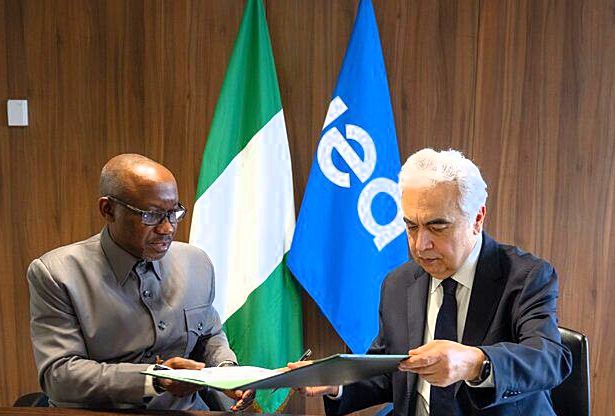
The federal government has signed a Memorandum of Understanding (MoU) with the International Energy Agency (IEA) to strengthen cooperation on methane emissions reduction, gas development, clean cooking access and technical support in Nigeria.
The development was disclosed in a statement issued Tuesday by the spokesperson for the Minister of State for Petroleum Resources (Gas), Louis Ibah.
According to the statement, the agreement was signed at the IEA headquarters in Paris, France, on Tuesday.
Speaking at the signing ceremony, the Minister of State for Petroleum Resources (Gas), Ekperikpe Ekpo, said the MoU formalises a strategic partnership aimed at improving efficiency, strengthening governance and aligning Nigeria’s petroleum industry with global best practices.
He said the collaboration builds on previous engagements between both parties, including the inaugural Sub-Saharan Roundtable on methane emissions reduction hosted in Nigeria.
“This MoU marks an important milestone in our collective efforts to advance the Nigerian petroleum sector in a manner that is efficient, sustainable and aligned with global standards,” Mr Ekpo said.

He explained that the framework covers methane emissions reduction, policy and analytical support, institutional and technical capacity building, data sharing, gas development and expansion of gas infrastructure.
Mr Ekpo also identified clean cooking as a key pillar of the agreement, noting that the Federal Government, under President Bola Ahmed Tinubu, is targeting five million households for Liquefied Petroleum Gas adoption by 2030.
He expressed confidence that the partnership with the IEA would provide technical expertise and global insights to strengthen project bankability and accelerate infrastructure delivery.
The IEA Executive Director, Fatih Birol, who represented the agency at the signing ceremony, commended Nigeria’s commitment to methane reduction and the expansion of clean cooking gas access.
Methane and climate concerns
Methane is a colourless, odourless and flammable gas that is the primary component of natural gas. While widely used for heating, cooking and electricity generation, it is also a potent greenhouse gas — more than 28 times more effective at trapping heat than carbon dioxide over a 100-year period.
According to the IEA, methane emissions in Nigeria’s oil and gas sector occur mainly through intentional venting, inefficient flaring and leaks from ageing infrastructure.
READ ALSO: Groups demand effective laws to cut methane emissions in Nigeria’s oil sector
In 2023, the agency reported that venting and fugitive emissions significantly contributed to the high methane intensity of Nigeria’s upstream operations, which it estimated to be roughly double the global industry average.
As part of its Nationally Determined Contributions (NDCs) submitted to the United Nations Framework Convention on Climate Change, Nigeria has pledged to reduce methane emissions.
The country has also introduced upstream, midstream and downstream methane regulations under broader sector reforms following the passage of the Petroleum Industry Act.
The IEA has indicated that Nigeria has significant potential to curb methane emissions. In 2023, it estimated that about 67 per cent of the country’s methane emissions could have been avoided at no net cost through the sale of captured gas.
This assessment has informed government targets to end routine gas flaring by 2030 and reduce fugitive methane emissions by 60 per cent by 2031.
Last month, experts from civil society organisations operating in Nigeria and across Africa called for stronger laws and stricter enforcement to address persistent methane emissions in the oil and gas sector, citing growing health and environmental concerns in Niger Delta communities.
The experts argued that methane reduction is both achievable and cost-effective, noting that proven technologies already exist to significantly cut emissions, often at low or no net cost when captured gas is properly utilised.