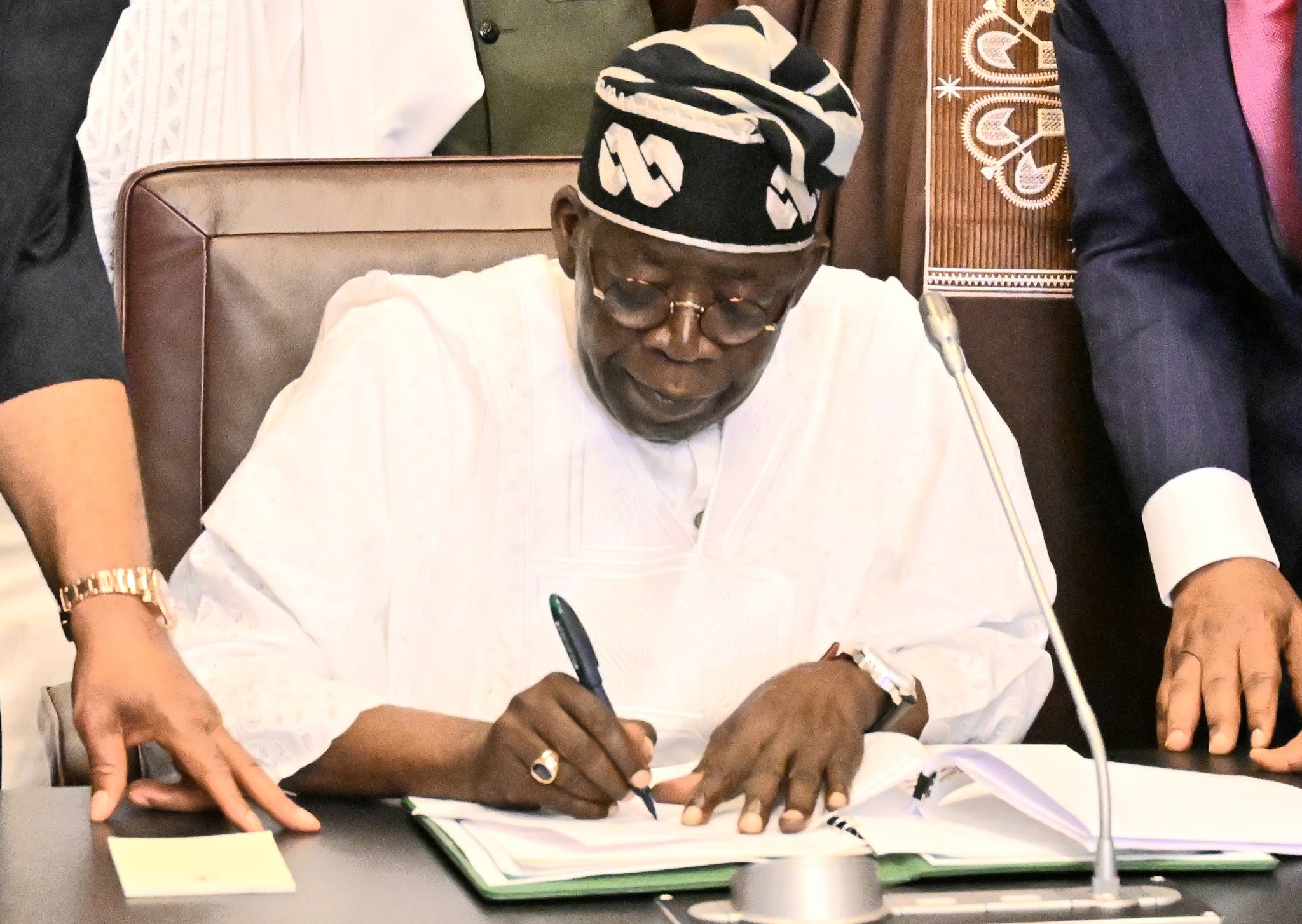
President Bola Tinubu on Wednesday signed the Electoral Act 2026 (Amendment) into law ahead of the 2027 general elections, amid renewed concerns over the transmission of election results.
The development was reported by Voice of Nigeria, which stated that the signing ceremony took place at the State House, Presidential Villa, Abuja.
The amendment followed days after the National Assembly passed the revised legislation, sparking fresh debate over the adoption of a hybrid system combining electronic and manual transmission of results, particularly in areas with network challenges.
The new law coincides with the recent release of the Notice of Election and timetable by the electoral umpire.
What the President said
The signing of the amended legislation was witnessed by principal officers of the National Assembly, days after a rowdy session had trailed its passage.
The President highlighted that “It is time to have confidence in our system”, adding that no matter how good a system is, it’s managed by people, promoted by the people, and the result is finalised by the people.
- “In fact, for final results, you are not going to be talking to the computer. You are going to be talking to human beings who announce the results,” he said.
- The President continued, “As long as you appear personally as a manual voter in any polling booth, a ballot paper is given to you, and you cast your vote without hindrance, ballots are counted manually, it’s just the arithmetic accuracy that is entered into the system”
Backstory
This development also followed the formal release of the Notice of Election and the Timetable and Schedule of Activities for the 2027 General Elections by the Independent National Electoral Commission (INEC).
INEC leadership had previously reaffirmed its independence and neutrality, outlining strategic focus areas aimed at strengthening public confidence in the 2027 electoral process.
The renewed emphasis on technology stems from prolonged legislative debates over amendments to the Electoral Act 2022. Lawmakers had initially rejected mandatory electronic transmission of election results from polling units to INEC’s Result Viewing Portal (IREV) after vote counting, triggering public outcry and protests at the National Assembly complex.
The Senate later rescinded its earlier decision following backlash from civil society groups and stakeholders.
The upper chamber subsequently re-amended the Electoral Act to accommodate electronic transmission of results.
The amendment was based on a motion moved by Senate Chief Whip Tahir Monguno during an emergency plenary session.
The new provision allows manual transmission using Form EC8A as the primary means of result collation in cases of internet failure.
The compromise effectively introduced a hybrid system that combines electronic transmission with manual collation where technological limitations exist, reflecting ongoing concerns about digital infrastructure and legal clarity since the 2023 elections.
What you should know
The amendment comes as INEC undergoes a leadership transition ahead of the 2027 polls. In 2025, the Senate confirmed Professor Joash Amupitan (SAN) as the new Chairman of INEC following his approval by the National Council of State.
- His confirmation was presided over by Senate President Godswill Akpabio after hours of screening by lawmakers.
- Amupitan responded to questions on electoral reforms and operational readiness during the plenary session.
- Nairametrics previously reported on October 9 that the National Council of State had approved his nomination, paving the way for Senate confirmation.
In addition, INEC has proposed a N209 billion budget to the National Assembly to cover technological requirements for the 2027 elections, subject to legislative approval, underscoring the financial implications of expanding digital infrastructure for the polls.