UEFA’s newly released financial report for the 2024/25 season confirms one thing clearly: elite European football is operating at record commercial strength, and the Champions League remains its primary engine.
According to UEFA’s 2024/25 Financial Report released on Thursday afternoon, they generated just over €5 billion in revenue during the season, despite it not being a EURO tournament year.
The bulk of that income came from club competitions, reinforcing how central the Champions League, Europa League and Conference League have become to UEFA’s financial ecosystem.
From the total revenue pool, approximately €3.9 billion was redistributed to clubs and national associations participating in UEFA competitions. After operational costs and solidarity allocations were accounted for, net earnings from men’s club competitions stood at roughly €3.58 billion, with the overwhelming majority returned to clubs.
PSG lead Europe’s earnings table
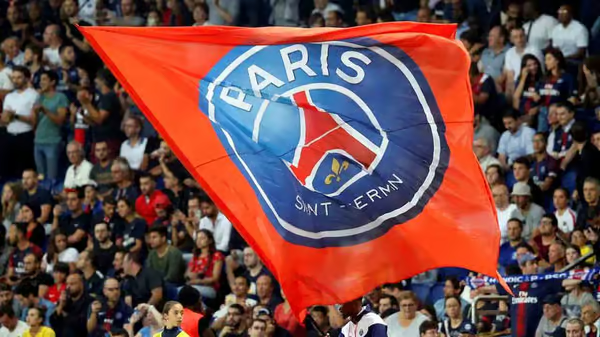
At club level, Paris Saint-Germain, the defending Champions of the UEFA Champions League emerged as the biggest financial beneficiaries of the 2024/25 Champions League campaign.
The French champions earned €144.4 million following their run to the final, making them the highest-earning club in Europe from UEFA prize distributions this season.
Inter Milan followed closely behind with €136.6 million, while Arsenal were the top English earners after reaching the semi-finals, banking €117 million.
Liverpool, eliminated in the Round of 16, earned €98 million. Aston Villa’s quarter-final appearance brought in €84 million, while Manchester City generated €76 million after exiting at the same stage as Liverpool.
The numbers illustrate how progression in the Champions League now directly translates into substantial financial upside.
How the new format shaped payouts
The 2024/25 season marked the introduction of the expanded 36-team league phase format, a structural change that also adjusted how prize money is allocated.
UEFA set aside €2.437 billion for distribution among Champions League clubs from the league phase onward. That amount was divided into three major components:
A fixed participation bonus
Performance-based payments tied to match results and final standings
A newly introduced “value pillar” combining broadcast market influence and historical coefficient ranking.
Clubs were paid per win and per draw during the league phase, meaning performance consistency became financially critical.
On average, clubs that reached at least the league phase earned around €57 million, with even the lowest-ranked participants securing €22 million — before factoring in progression bonuses.
For clubs that advanced deep into the competition, revenues accelerated significantly.
Europa League and Conference League: The financial gap
While the Europa League and Conference League continue to offer competitive relevance, the financial disparity compared to the Champions League remains wide.
Tottenham Hotspur earned €41 million for winning the Europa League, while Manchester United received €36 million as runners-up.
In the Conference League, Chelsea’s title triumph generated €22 million.
When the total club distribution is broken down, approximately three-quarters of the €3.35 billion allocated to clubs went to Champions League and Super Cup participants. The Europa League accounted for 17%, while the Conference League received under 9%.
The Champions League remains the dominant revenue channel.
Media rights remain UEFA’s backbone
A deeper look at UEFA’s income structure reveals that broadcasting rights continue to underpin its business model.
Media rights contributed more than €4 billion of the governing body’s overall revenue, representing over 80% of total income. Commercial partnerships and sponsorship agreements accounted for nearly €787 million.
The scale of media income highlights the enduring global demand for elite European football, particularly from emerging broadcast markets in Africa, Asia and North America.
For Nigerian football audiences and investors monitoring global football economics, this underscores why European competitions command premium rights fees and consistent advertiser interest.
Redistribution and reinvestment
UEFA retained just over €233 million from net competition revenue for reinvestment and administrative purposes. The rest was channelled back into the football ecosystem.
Solidarity payments — funds directed toward clubs not participating in the group stages and toward national associations, remain a central component of UEFA’s financial model. Together with competition payouts, redistribution accounts for more than 86% of UEFA’s total expenditure.
This approach allows smaller leagues and grassroots structures to benefit indirectly from the commercial power of elite competitions.
Champions League qualification: A financial necessity
For Europe’s major clubs, qualification for the Champions League has evolved from sporting ambition to financial necessity.
Arsenal’s €117 million earnings demonstrate how a deep run can significantly strengthen annual revenue streams. In contrast, even winning the Europa League delivers less than one-third of what PSG earned from reaching the Champions League final.
The new competition format, particularly the value pillar mechanism, also favours clubs from larger broadcast markets. This dynamic may further consolidate financial strength among Europe’s top five leagues.
For publicly traded clubs and football investors, Champions League participation now materially impacts financial forecasting, commercial negotiations and long-term valuation metrics.
A record-setting year for European football
UEFA’s 2024/25 financial results underline the commercial resilience of elite football. Total revenue surpassing €5 billion in a non-tournament year signals structural growth rather than one-off spikes.
With €3.35 billion distributed directly to clubs, up significantly from the previous season, European competitions remain one of the most powerful revenue-generating sports properties globally.
As PSG’s €144.4 million windfall illustrates, success in the Champions League is no longer just about prestige.
It is about the financial scale.
And for Europe’s biggest clubs, it increasingly feels like the Champions League, or nowhere.