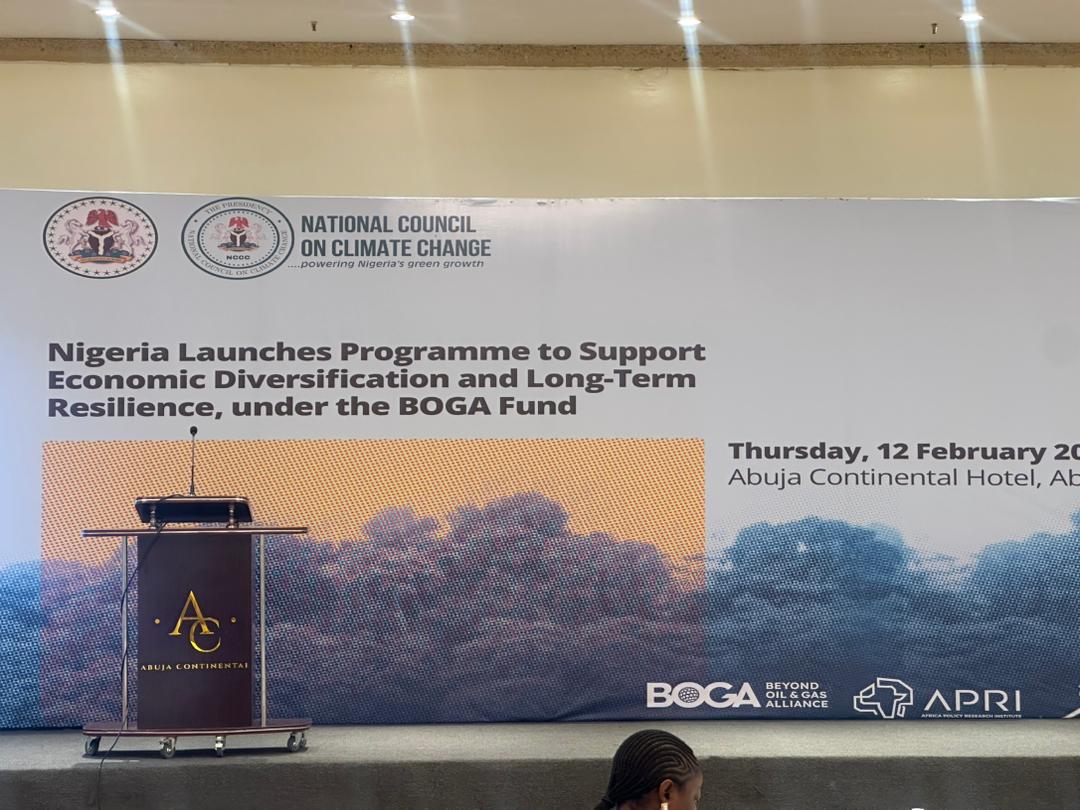
The federal government has launched the Nigeria Beyond Oil and Gas Alliance (BOGA) Fund Programme to support long-term economic diversification beyond oil and gas, including in rural communities across the country.
The initiative was launched on Thursday in Abuja at an event organised by the Nigerian Council on Climate Change (NCCC), in partnership with the Africa Policy Research Institute (APRI) and the Beyond Oil and Gas Alliance (BOGA).
The event brought together senior government officials, development partners, private sector representatives and civil society organisations to chart a pathway for structural transformation in Africa’s largest oil producer.
In his remarks at the event, the Minister of Budget and Economic Planning, Abubakar Bagudu, underscored the need for a deliberate and strategic approach to diversification.
He said Nigeria must better harness its unique strengths while leveraging technology and skills to drive sustainable growth, stressing that economic transformation should be anchored on climate consciousness.
According to him, Nigeria has the opportunity to grow its economy in ways that minimise environmental impact while strengthening resilience and creating jobs.


“We have missed historic opportunities. We can learn from those lessons so that we can do better. We are not where we want to be, but with the right choices — courageous choices — we will get there,” he said.
Mr Bagudu explained that the Nigerian government needs to create jobs and achieve sustainable economic growth. However, he said, “But if we pursue growth the wrong way, we may destroy the environment and climate in ways our children will not remember kindly.”
“Nigeria’s journey beyond oil and gas is not only about diversification; it is about valuing our uniqueness — utilising all the strengths available to us to generate value sustainably and responsibly,” he told the participants.
The minister explained that what is missing is a strategy — one that will support Nigerian farmers, fishers, miners and artisans with science, technology and skills so they can generate more value from what they do, responsibly and sustainably.
“It is possible to generate economic growth with minimal damage to the environment. That is not just common sense — it is existential for us,” he noted.
“Evolution into a green energy giant”
In her keynote address, the Director-General of the NCCC, Omotenioye Majekodunmi, described the initiative as a critical step in Nigeria’s transition journey.
“Nigeria’s journey beyond oil is not a retreat from our status as an energy powerhouse, but an evolution into a green energy giant,” she said.

“Our collaboration with BOGA reinforces our commitment to the 1.5°C pathway while prioritising a development trajectory that is fair, funded, and focused on the prosperity of our people.”
The NCCC boss said the programme is not about abrupt change or economic disruption; it is about forward-looking measures, building our ability to anticipate risks and seize new opportunities.
“This three-year programme is designed to deliver three critical outcomes: strengthening the analytical foundation for policymaking, placing people at the centre of economic planning, and expanding opportunities for women and youth,” she said.
Ms Majekodunmi explained that economic resilience cannot rest on a single foundation, and that diversification is not a rejection of Nigeria’s strengths; it is an investment in stability, competitiveness, and long-term prosperity.
“Nigeria is not simply responding to global change; we are strategically shaping our own future,” she noted.
On her part, Sian Bradley, Head of the BOGA Secretariat, who delivered her goodwill message virtually, reiterated the alliance’s commitment to supporting countries at an early stage of planning for a just, orderly and equitable transition away from oil and gas.
She commended Nigeria’s acknowledgement of economic challenges and diversification pathways in its third Nationally Determined Contribution (NDC), noting that the programme would support early implementation efforts alongside broader decarbonisation, methane reduction and upstream emissions-cutting initiatives.
Evidence-based transition planning
Through scenario analysis, transition risk assessments and evaluation of green development pathways, the organisers explained that the programme will examine impacts across Nigeria’s oil and gas value chain while identifying viable economic alternatives.

It will also develop targeted policy recommendations to support workers and communities that may be affected by structural shifts in the energy sector.

Speaking on behalf of APRI, the programme’s lead implementing partner, its Executive Director, Olumide Abimbola, said the initiative would help Nigeria develop a clearer and shared understanding of what changes in the global energy system mean for national revenues, jobs, industries and communities.
“It will also help us identify credible pathways for economic diversification beyond oil and gas, and the kinds of policies and enabling conditions needed to unlock new opportunities and drive competitiveness,” he said.
On his part, Chukwumerije Okereke, Director-General of the Society for Planet and Prosperity (SPP), who was represented by Timothy Ogenyi, noted that Nigeria’s challenge goes beyond simply moving away from fossil fuels.
“Nigeria’s challenge is not simply to transition away from fossil fuels, but to strategically manage the risks and opportunities of a changing global energy system,” he said, adding that the BOGA Fund Programme anchors the transition in rigorous evidence, economic realism and justice for workers and communities.
Cross-government coordination
The programme is being implemented by APRI in collaboration with SPP. Its development in Nigeria was led by the NCCC, which established a cross-government working group that includes representatives from the Ministry of Petroleum, the National Upstream Petroleum Regulatory Commission, the Nigerian Midstream and Downstream Petroleum Regulatory Authority, the Ministry of Environment and the Nigerian National Petroleum Company.
READ ALSO: ANALYSIS: The price Tinubu would’ve paid if Fubara had been impeached
At the event, officials said the Nigeria BOGA Fund Programme complements ongoing national and international climate efforts by providing an integrated platform for evidence-based policymaking, institutional coordination and long-term economic resilience.
For Nigeria, whose economy remains heavily dependent on oil revenues, the initiative signals a structured attempt to prepare for a future in which global energy markets are increasingly shaped by decarbonisation and green growth priorities.