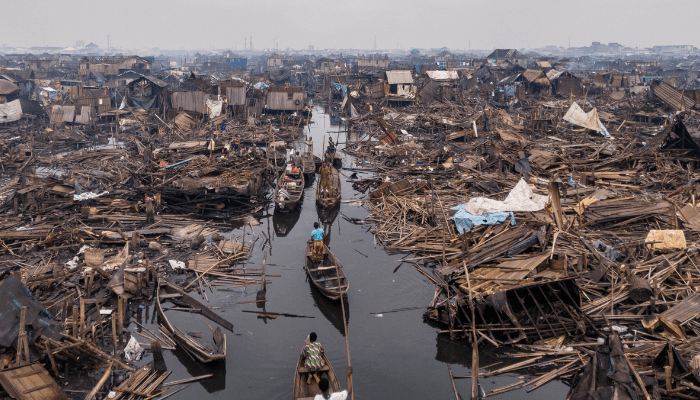
An advocacy group, Corporate Accountability and Public Participation Africa (CAPPA), has revealed that recent demolitions carried out by the Lagos State Government in Makoko and Oworonshoki displaced more than 10,000 residents.
Bloomberg reported the development, citing the group, which said the exercise also affected over 3,000 dwellings in the two areas.
The group’s position follows the ongoing levelling of the floating Makoko settlement and parts of Oworonshoki, for reasons the Lagos State Government said were based on the collective good of the state.
What they are saying
CAPPA claimed that the demolitions, which began in December and were ongoing, had resulted in the destruction of thousands of homes across the two communities.
The group alleged that many affected residents were left without alternative accommodation, forcing some to seek temporary shelter in boats, churches, school buildings, or open spaces.
“The recent demolitions, which started in December and are ongoing, have affected more than 3,000 dwellings and displaced more than 10,000 people, according to Corporate Accountability and Public Participation Africa, or Cappa, a Lagos-based governance-advocacy group,” the Bloomberg report read in part.
CAPPA said the Makoko demolitions were initially limited to structures within 50 meters of power lines, but the government later extended the zone to 100 meters, exceeding legal standards of 30 to 50 meters.
The expansion increase affected households and disproportionately impacted low-income residents who rely on the waterfront for fishing and small-scale trading, it noted.
The report said a human rights group, Take It Back Movement, alleged that compensation for verified homeowners ranged from N300,000 to N5 million, with some residents rejecting it as inadequate for the value of their properties.
Lagos government’s position
The Lagos State Government has maintained that the demolitions were part of an urban regeneration programme to improve infrastructure and public safety, with compensation for verified homeowners.
Governor Babajide Sanwo-Olu said that in Makoko, evacuation notices had been served over two years before the demolitions, particularly for buildings located 150 to 250 meters from high-tension wires.
- He emphasized that the exercise was conducted in the collective interest of Lagos and its residents, and that affected residents would receive palliatives and relocation stipends.
- The Lagos State Building Control Agency (LASBCA) said the Oworonshoki demolitions, which took place at the end of 2025, followed due process, with affected structures served notices and given time under an amnesty programme.
The agency noted that most residents ignored warnings, and the demolished buildings were distressed, blocked drainage channels, and posed safety risks.
What you should know
The Makoko waterfront settlement, which has been partially levelled, was known for its challenging living conditions.
A 2024 Nairametrics report revealed that a single room costs N5,000 per month (N60,000 annually), while two rooms go for N15,000 monthly (N180,000 annually). New residents are often required to pay three years’ rent upfront, along with N100,000–N150,000 for damages, agreements, and agent commissions.
Most homes are one- or two-room wooden structures, many built over the lagoon, with only a few buildings on land, none of which provide basic amenities. Residents must also pay N100 per use to access shared bathing or toilet facilities.
The Lagos State Government has previously carried out the removal of dwellings under power lines for safety reasons, based on regulations in the State Urban and Regional Planning and Development Law.
The Makoko demolitions, in particular, involved structures deemed too close to high-tension wires. The law prohibits construction beneath overhead electricity wires and sets minimum distances between buildings and power lines:
- 0.415KV and 11KV lines: 6 meters
- 33KV lines: 10 meters
- 132KV lines: 20 meters
- 330KV lines: 30 meters
The government said evacuation notices had been served to residents living within 150 to 250 meters of high-tension wires, exceeding the minimum distances required by law.